1 Write how small actions you do each day, like smiling at someone or helping a friend make a difference in the lives of others ?

2 Answer the following questions :

1. What two small things are compared to the mighty ocean and pleasant land in the poem?

2. How do "little moments" affect "mighty ages," according to the poem?

3. What can happen when we make "little errors," as described in the poem?

4. What kinds of "little deeds" and "little words" can make the earth happy?

5. How does the poet compare our world to "Heaven above"?

3 Value-Based Questions:

1. How can little deeds of kindness change the world around us? Share an example from your own life.

2. Why is it important to think about how our "little errors" can affect others? How can we avoid making mistakes that hurt others?

4 Here is the summary of the poem with a few words missing. Complete it.

1. In the first stanza, the poet explains how ___________ _______ have great importance in life. She expresses that __________________________________ make huge oceans and ____________________________ make beautiful lands.

2. In the second stanza, the poet explains that the little moments of life, turn into ages and _______________ lifetime. She says ____________ have great meaning and impact on us.

3. In the third stanza, the poet says that _____________ _______________________________ creates a huge difference in life. Our little ______________________ lead the soul away from the right path. So we should prevent ourselves from making even a tiny mistake.

4. In the last stanza, the poet says that the little _______ and little ____________________ make the earth like heaven and the earth becomes a better place to live in. She says that little things make everyone happy and are greatly responsible for changing our lives.

5 State whether the following sentences are True or False:

1. Little words of love do not affect the world. _________

2. Small mistakes can lead us away from the path of virtue. _________

3. Only big actions can change the world. _________

4. The poem teaches that both good and bad actions can have lasting effects. _________

6 Read the following and say whether it is a Sentence or a Phrase:

1. Playing in the park. _____________________

2. The sun is shining brightly. _____________________

3. Under the bed. _____________________

4. She reads books every evening. _________________

5. Across the river. _____________________

6. The dog barked loudly. _____________________

7. The old lady is sitting on the chair. _______________

8. To the market. _____________________

7 Complete the following sentences by adding a Suitable Phrase:

1. The children are playing ______________________.

2. She is reading a book ____________________.

3. They went ____________________ for their vacation.

4. The bird flew ____________________.

5. I saw a cat ____________________.

6. The dog is hiding ___________________.

7. We saw many animals___________________.

8. Flowers are blooming _______________________.

8 Make a chart, writing phrases about how you can show kindness in your everyday activities. Take a clue from the picture given.

1 Answer the following questions :

1. Why was the garden so special for the children?

2. What did the Giant do when he saw the children in his garden for the first time?

3. How did the garden change after the Giant chased the children away?

4. Why was there no spring in the Giant's garden even when it came everywhere else?

5. What did the Giant realise when he saw the children back in his garden?

6. Why did the Giant help the little boy?

7. What happened to the Giant when the boy took him to the Garden of Paradise?

8. What message does the story convey about love, kindness, and generosity?

2 Value-Based Questions:

1. What lesson can we learn from the Giant's change in behaviour from being selfish to selfless?

2. How does the relationship between the Giant and the children highlight the importance of friendship?

3 Match the Column:

4 In the following sentences, underline the Subject:

1. The flowers bloomed beautifully.

2. The children played in the garden

3. The dog chased the cat down the street.

4. The chef prepared a delicious meal for the guests.

5. A strong wind blew through the trees.

6. The birds flew south for the winter.

7. The new student quickly made friends in the class.

8. An astronaut landed on the moon.

5 In the following sentences, the Subject is missing. Fill in the blank with a suitable Subject:

1. ___________ ran across the field.

2. ___________ finished the homework on time.

3. ___________ barked loudly at the stranger.

4. ___________ is reading a mystery novel.

5. ___________ started raining heavily in the evening.

6. ___________ danced all night at the party.

7. ___________ teaches mathematics to the class.

8. ___________ cleaned the kitchen after dinner.

6 In the following sentences, the Predicate is missing. Complete the sentence by adding a suitable Predicate:

1. The baby

2. The birds

3. My friends

4. The teacher

5. A tall building

6. The bus

7. The children

8. The wind

1 Answer the following questions :

1. How does Neha wake up in the morning?

2. Why does Neha say that she can get up late the next day?

3. What does Neha wish for the sun? What happens to the sun on the next day?

4. Who fills Neha's room with a warm smile?

5. Who wakes up Neha by calling her a sleepy head?

6. Why does Neha eat her lunch every day at one in the afternoon?

2 Value-Based Questions:

1. Discuss why it's important to overcome laziness and follow routines.

2. Why is it important to be disciplined in our life? How can we avoid making mistakes by following a timetable?

3 Who said these words and to whom? Tick the correct speaker :

1. "Wake up dear! Wake up fast !" Bird Narrator

2. " Ma, Who woke me up today ?" Neha Mother

3. “Why do you sleep at nine every night?” Mother Neha

4. "There is a clock inside you." Sun Mother

4 Tick (√ ) the correct answer.

1. What time did Neha's clock ring every morning?

(a) 4 o'clock

(b) 9 o'clock

(b) 6 o'clock

2. What did the birds say?

(a) sleep on

(b) wake up

(c) go and play

4. What is inside you that makes you get up at the same time every day?

(a) our body clock

(b) our eyes

(c) our feet

5. Who filled Neha's room with a warm smile?

(a) her father

(b) the moon

(c) the sun

5 Change the Nouns in brackets into their Plural form Change the Verb according to the Subject .

1. The (baby) is crying loudly.

2. A (potato) is placed on the (shelf).

3. The (thief) ran away from the (cliff).

5. A (hero) was awarded for his bravery.

6. The (leaf) fell from the (tree).

6 Change the following Nouns from Plural to Singular.

1. Wolves ________

2. Potatoes ________

3. Pianos ________

4. Calves ________

5. Thieves ________

6. Stories ________

7. Babies ________

8. Glasses ________

9. Heroes ________

10. Knives ________

7 Change the gender of the Nouns in brackets:

1. The (actor) gave an amazing performance.

2. My (uncle) is a great storyteller.

3. The (waiter) served us dinner quickly.

4. The (landlord) came to collect the rent.

5. The (tiger) roamed through the forest.

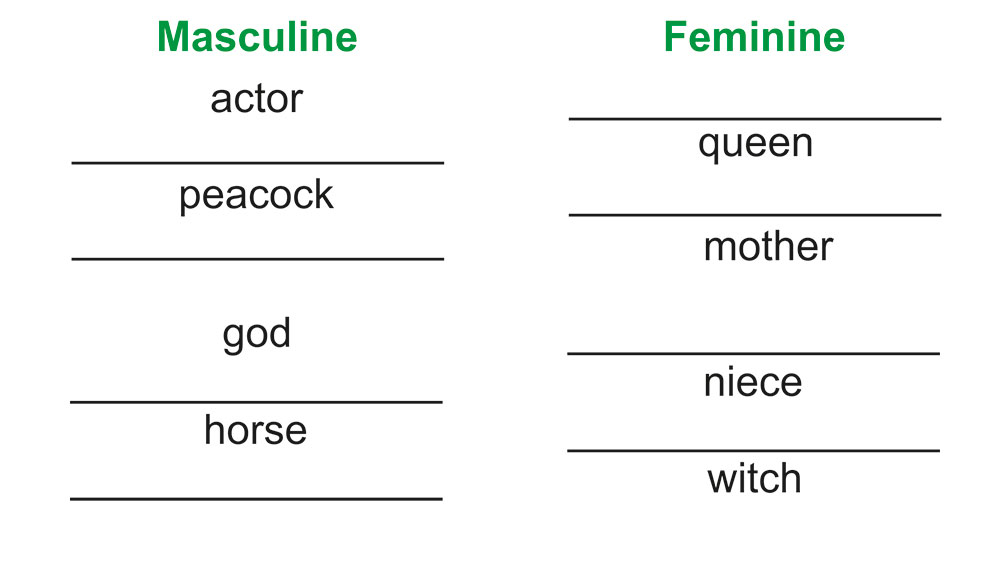
8 Fill in the blanks with Masculine or Feminine gender:
9 Read the paragraph and tick the correct answers:

Once upon a time in a small village, there was a young boy named Ravi. Ravi loved to play and have fun, but he often forgot to do his homework. His teacher, Miss Mira, told him, "Ravi, if you want to do well in school, you must be disciplined." One day, Ravi decided to change. He made a schedule to finish his homework before playing. At first, it was hard, but soon he found that he could enjoy both studying and playing. His grades improved, and he felt proud of himself. Ravi learned that discipline helps him achieve his goals, and it makes him happier!

1. What did Ravi often forget to do?

a) play outside

b) eat his meals

c) do his homework

d) visit his friends

2. Who advised Ravi about discipline?

a) his parents

b) his friend

c) his teacher, Miss Mira

d) the village chief

3. What did Ravi create to help him?

a) a toy

b) a schedule

c) a game

d) a storybook

4. How did Ravi feel after he became disciplined?

a) sad

b) angry

c) proud

d) tired

5. What lesson did Ravi learn?

a) Discipline is unimportant.

b) Discipline helps him achieve his goals.

c) Playing is more important than studying.

d) Homework is boring.

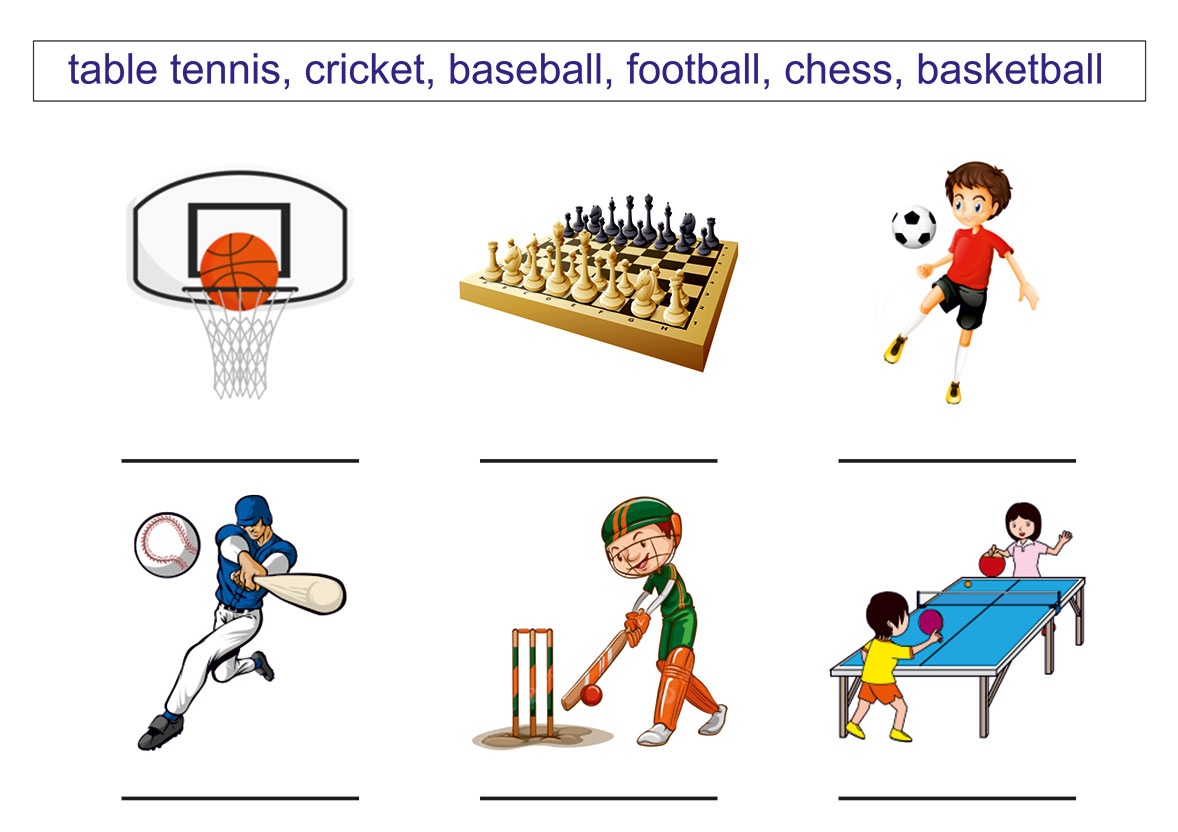
1 Look at the pictures and identify the sports shown. Take help from the clues given in the box.
2 Answer the following questions :

1. What did Nasruddin boast about?

2. What did Nasruddin's friend do when Nasruddin started boasting?

3. What happened when Nasruddin shot the arrow the first time?

4. Why did Nasruddin's friends laugh at him?

5. Did Nasruddin succeed in his second attempt?

6. Whose aim was it the second time around?

7. "Did you see that?" Who said this to whom and why?

8. Why did Nasruddin say, "It was my aim," the third time?

9. Do you think Nasruddin was good at archery?

10. Why did Nasruddin take someone else's name each time he missed the target?

3 Value-Based Questions:

1 Do you think it is important to be always truthful about your abilities? Why or why not?

2. Is it right to be boastful and try to present a better picture of oneself in front of others?

4 State 'T' for True and 'F' for False statements.

1. Nasruddin never boasted about anything. _________

2. Nasruddin was good at archery.______________

3. Every time Nasruddin missed his target, he took

4. Nasruddin hit his aim the third time.____________

5. Nasruddin was good at basketball.

5 Fill in the blanks. Help is given in the box. (lucky, arrow, archery, laughing, target.)

1. Nasruddin was not good at ___________

2. Nasruddin's friends started ___________

3. Nasruddin picked up another ___________

4. Nasruddin was really ___________

5. Nasruddin hit the ___________ the third time.

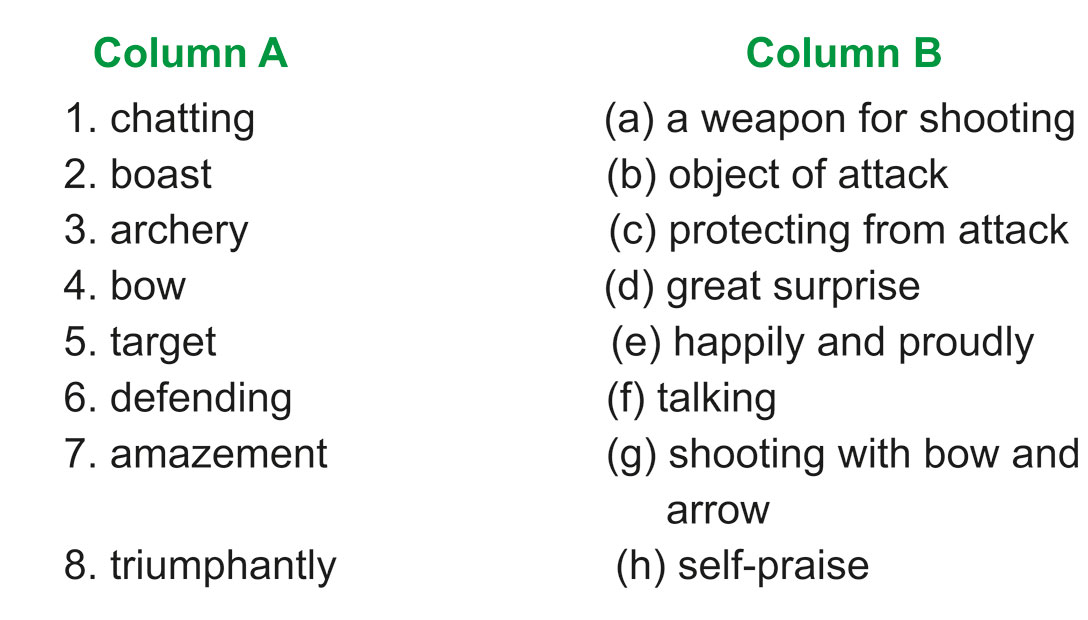
6 Match the words in Column A to their meanings in Column B.
7 Fill in the blanks with the correct Possessive Noun using the words in brackets.

1. The _____________ bone is buried in the yard. (dog)

2. _____________ book is on the table. (Sarah)

3. The _____________ lesson was interesting. (teacher)

4. The _____________ whiskers are long. (cats)

5. _____________ shoes are muddy. (Tom)

6. My _____________ bike is broken. (friend)

7. The _____________ toy is colourful. (child)

8. _____________ car is new. (Mom)

8 Rewrite the following sentences by changing the Nouns into their Plural Possessive forms. The first one is done.

1. The tails of the dogs were wagging.

2. The lounge of the teachers is upstairs.

3. The food bowls of the cats are empty.

4. The books of the children are scattered.

5. The uniforms of the players were clean.

6. The party of the friends was fun.

7. The homes of the families are close to each other.

9 Write the name of your favourite sportsperson. Explain in 6-8 lines why do youlike him/her. You may add more information about him/her based on the hints given below. (Hints:- full name, his/her game/ sports, birthplace, achievements etc.)

1 Given below are the pictures of the sensory organs. Name them and also write the work they do :`

2 Answer the following questions :

1. What did the speaker find funny about their nose?

2. What parts of the face did the speaker see in the mirror?

3. Why do you think the speaker describes the nose as a "handle"?

4. According to the speaker, what should you do if you want to giggle and shout?

5. What are the two little holes in the nose used for?

6. What are some funny or interesting things you notice about your face when you look in the mirror?

7. How does looking at your face in the mirror make you feel?

3 Value-Based Questions:

1. The speaker finds joy and humour in something as simple as looking in the mirror. How can we learn to appreciate small things in our everyday life?

2. How important is it to laugh and enjoy ourselves every day? How can humour make us happier?

4 Complete the following Sentences:

1. The speaker looked in the mirror and saw _________

2. The nose has two little holes where ______________ ____________ goes.

3. The speaker describes the nose as a _____________.

4. If you want to giggle and shout, just ______________.

5. The speaker saw the end of their ________________ and the start of their ___________.

5 State whether the following sentences are True or False:

1. The speaker thinks the nose is funny because it looks like a handle. _____

2. The poem talks about how ears help in breathing._____

3. The speaker feels sad after looking in the mirror._____

4. The nose is located between the chin and the hair._____

5. The poem suggests that looking in the mirror can make you laugh. _____

6 Find rhyming words in the poem for the following:

1. nose ___________________

2. shout ___________________

3. hair ___________________

4. spare ___________________

5. doubt ___________________

7 Fill in the blanks choosing the correct option :

1. _____ (She/They) is going to the park.

2.This book belongs to _____ (me/they).

3. _____ (We/He) are having lunch together.

4. Can _____ (you/I) help me with this task?

5. _____ (It/They) is raining outside.

6. The red car is _____ (his/I).

7. _____ (Her/Him) dog is very friendly.

8. _____ (We/Your) need to finish our homework.

9. _____ (Them/She) gave me a gift yesterday.

10. This house is _____ (mine/it).

8 Correct the Pronoun:

1. I gave the book to her, but he lost it.

2. They are coming to the party, but them forgot the gift.

3. Us are going to the zoo tomorrow.

4. She loves her dog; she plays with her every day.

5. Can you lend I your pencil?

1 Answer the following questions :

1. What materials are used to construct igloos, and how do they provide insulation?

2. How do tents serve the needs of nomadic tribes?

3. Describe the design features of a boathouse and its importance in coastal living.

4. What are the advantages of living in a bungalow in a tropical climate?

5. How do apartments save space in urban are as?

6. Why skyscrapers are found in densely populated cities?

7. How do environmental factors influence the construction materials used in different types of houses?

8. What problems do people face living in tents?

9. In which regions boathouses are more common and why?

2 Value-based Questions:

1. Why is it important to understand the importance of the houses we live in?

2. What are the things that we can use in our houses to save our environment ?

3 Match the House to the Region

a) boathouse - tropical areas

b) skyscraper - near rivers and lakes

c) bungalow - major modern cities

d) apartment - arctic region

e) igloo - urban cities

4 State whether the following statements are True or False:

1. Igloos are built with ice blocks. _________

2. Tents are used by people who stay in one place. _________

3. Boathouses are designed to store boats. __________

4. Bungalows have wide verandas for outdoor living. ________

5. Apartments are commonly found in remote rural areas. _______

6. Skyscrapers are built to accommodate large numbers Of people in small spaces. ________

7. Tents are used only in modern times for camping. ________

8. Boathouses are built on stilts to prevent flooding. ________

9. Bungalows are ideal for colder regions with little Sunlight. ________

10. Skyscrapers use advanced engineering to handle Wind and earthquakes. ________

5 Fill in the Blanks

1. Tents are easy to ____, making them suitable for Nomadic people.

2. Skyscrapers are built using advanced ______.

3. Boathouses are often built on ____ to avoid flooding.

4. The inuit people build ____ to survive the cold arctic weather.

5. Apartments are common in ____ areas where space Is limited.

6. Bungalows are designed with large ____ to allow fresh air inside.

7. Nomadic people use tents because they are easy to ____ and carry.

8. A ____ is a type of home that is portable and made from fabric or animal skins.

9. The design of a ____ helps people live in a tropical climate with plenty of ventilation.

10. A ____ allows thousands of people to live or work in tall buildings in cities.

6 In each sentence below, circle the Verb.

1. She sings beautifully.

2. The dog runs fast.

3. They are playing in the park.

4. We read a story last night.

5. John dances at the party.

6. The teacher teaches us every day.

7. I eat lunch at noon.

8. The children jump on the trampoline.

9. Birds fly in the sky.

10. He writes a letter to his friend.

7 Choose the correct form of the Verb to complete the sentences.

1. The sun (shines/shine) brightly in the sky.

2. She (is/are) reading a new book.

3. They (plays/play) tennis on the weekends.

4. The baby (was/were) crying all night.

5. We (is/are) going to the park later.

6. He (write/writes) in his diary every day.

7. The kids (was/were) playing in the yard.

8. The dog (runs/run) after the ball.

9. She (sing/sings) very well.

10. I (am/are) excited about the trip.

1 Answer the following questions :

1. Where was Bachendri Pal born?

2. What was the first mountain Bachendri climbed?

3. In which year did Bachendri Pal climb Mount Everest?

4. What happened to the team during the ascent of Mount Everest?

5. How many days did the Great Indian Women's Rafting Voyage take?

6. What awards did Bachendri Pal receive?

7. How did Bachendri Pal help during the Uttarakhand floods?

8. What did Bachendri Pal prove with her life story?

9. What challenges did the Everest team face during the climb?

10. Why is Bachendri Pal's story so inspiring?

2 Value-based Questions:

1. How do you think a person can achieve their dreams?

2. What quality of Bachendri Pal you liked the most and why?

3 Number the sentences in the correct order based on the story of Bachendri Pal.

* Bachendri Pal became the first girl from her village to graduate. ________

* She climbed Mt. Gangotri and Mt. Rudragaria during her training at NIM. ________

* Bachendri participated in the Women Trans-Himalayan Expedition in 1997. ________

* In 1984, she was selected to climb Mount Everest as part of a 17-member team. ________

* During the Uttarakhand floods in 2013, Bachendri led rescue operations. ________

* At the age of 12, she climbed her first peak during a school picnic. ________

* In 1994, Bachendri took part in the Great Indian Women's Rafting Voyage. ________

* On May 23, 1984, she became the first Indian woman to reach the summit of Mount Everest. ________

* She received the Padma Shri in 1984 and the Arjuna Award in 1986. ________

* Bachendri led the Indo-Nepalese Women's Expedition in 1993. ________

4 Fill in the Blanks

1. Bachendri Pal was born in the village of ___________.

2. She became the first girl from her village to graduate and get a degree in ___________.

3. During her course at the NIM, Bachendri climbed Mt. ___________ and Mt. ___________.

4. In 1984, Bachendri was selected to climb __________.

5. Many of her team members quit after an __________ accident.

6. On May 23, 1984, Bachendri reached the ________ of Mount Everest.

7. In 1993, she led the _______ Women's Expedition.

8. The Great Indian Women's Rafting Voyage took _______ days.

9. In 2013, she helped during the floods in _______.

10. Bachendri Pal was awarded the _______ in 1984.

5 State whether the following sentences are True or False:

1. Bachendri climbed her first peak at the age of 15. ____

2. She was the only woman left in the Everest team by May 22, 1984. ____

3. The Indo-Nepalese Women's Expedition happened in 1993. ____

4. Bachendri Pal helped during the Kerala floods in 2013. ____

5. She won the Padma Shri award in 1984. ____

6. The Trans-Himalayan Expedition was a rafting expedition. ____

6 Choose the correct Verb:

1. The dog (runs/run) in the park.

2. My friends (is/are) coming to the party today.

3. There (is/are) many books on the shelf.

4. The boy and his sister (plays/play) outside.

5. Either the coach or the players (is/are) talking.

6. The class (is/are) going on a field trip tomorrow.

7. The cats (runs/run) after the ball.

8. The team (is/are) winning the match.

9. There (is/are) two apples on the table.

10. The teacher (reads/read) a story to the class.

7 Fill in the Blanks with the correct Verb

1. He ________ (play/plays) football every day.

2. They ________ (is/are) going to the zoo tomorrow.

3. The birds ________ (fly/flies) in the sky.

4. There ________ (is/are) a cat in the garden.

5. My parents ________ (is/are) very kind.

6. The school bell ________ (ring/rings) at 8 a.m.

7. She ________ (love/loves) reading books.

8. The group ________ (is/are) meeting today.

9. The students _______ (study/studies) hard for the test.

10. Either John or his friends _____ (is/are) coming over.

1 Answer the following questions :

1. What suddenly happened at the beginning of the story?

2. Where was the magician going when it started raining?

3. What did the magician see as he looked around during the rain?

4. Why did the fir tree feel sad at the beginning of the story?

5. What reward did the magician offer to the fir tree?

6. What happened to the tree's green leaves after its first wish?

7. What was the fir tree's second wish, and why did it make that wish?

8. What did the fir tree wish for the third time, and what happened to that wish?

9. What lesson did the fir tree learn after all its wishes were granted?

10. Why did the fir tree finally want its old needle-like leaves back?

2 Value-based Questions:

1. What does the fir tree's experience teach us about being satisfied with what we have?

2. Do you think it's never good to become like others? Give a reason for your answer.

3 Tick( ✔ ) the correct option.

(I) The pretty little fir tree was happy with gold leaves but _______________

(a) a goat came along and ate them

(b) all the leaves got wet in rain

(c) a man stole them

(ii) The fir tree was sad in the beginning of the story ____

(a) because it had yellow leaves

(b) because it had needle-like leaves

(c) because it was very short

(iii) The fir tree was not happy with the gold leaves ____

(a) because the goats came and ate them up

(b) thieves stole them

(c) the gold leaves broke

(iv) Shetty was a ______________

(a) pirate

(b) magician

(c) musician

(v) The magician _____________

(a) punished the tree

(b) cut the tree

(c) rewarded the tree

(vi) The fir tree had ______________ leaves

(a) needle shaped

(b) cone shaped

(c) round

4 Correct the spellings of the following words given in the story.

(I) shletre ___________

(ii) rewrad ___________

(iii) bidrs ___________

(iv) morgnin ___________

(v) laeves ___________

(vi) srupresid ___________

5 Fill in the blanks with the correct Tense of the Verb provided in brackets.

1. They ____________________________ (play) football when it started raining.

2. She _________________________________ (finish) her homework before dinner yesterday.

3. By this time next year, we ______________________ (complete) the project.

4. He ____ _________________________(work) here for three years by next March.

5. I ___________________________________ (meet) him at the party last week.

6. The students ______________________________ (study) for the exam right now.

7. We ______________________________________ (wait) for the bus for 20 minutes before it arrived.

8. Tomorrow, I _________________________________ (go) to the beach.

9. She ____________________________ (read) the book every day before going to bed.

10. By the end of the day, they ____________________ _____________ (write) three chapters of the book.

6 Select the correct tense form of the Verb from the options.

1. She (a. is writing, b. writes, c. wrote) a letter right now.

2. By the time you arrive, we (a. will have left, b. leave, c. left).

3. They (a. have been playing, b. play, c. played) soccer every Sunday.

4. I (a. had finished, b. finish, c. will finish) my work before she came.

5. He (a. is going, b. will have gone, c. has gone) to the gym twice a week.

7 Complete the Paragraph using the correct tense of the Verbs in brackets.

Yesterday, I __________ (go) to the park with my friends. We __________ (play) there for a few hours. While we __________ (play), it suddenly started raining. By the time we __________ (get) home, we __________ (be) completely wet. Today, the weather is sunny, and I ____ ______ (plan) to go to the park again tomorrow. Hopefully, it __________ (not rain) this time.

1 Answer the following questions :

1. With what things does the poet compare the speed of the train in the poem?

2. What sights does the poet mention as seen from the train?

3. How does the poet contrast the movement of the train with the people and things around it?

4. What effect does the poet create by using the phrase "in the wink of an eye"?

5. What pleasure does the railway journey give to the poet?

6. Why do you think the poet uses comparisons like "troops in a battle" to describe the train's movement?

7. Who is a tramp? What was the tramp, doing when the railway carriage passed?

2 Value-based Questions:

1. The poem talks about how fast life can be. How can we slow down and enjoy every moment of life ?

2. Why is it important to notice and appreciate small things in life?

3 Find rhyming words for the following words from the poem:

1. witches - __________

2. battle - __________

3. plain - _________

4. eye - __________

5. scrambles - __________

6. road - __________

4 Complete the passage based on the summary of the poem:

The poem describes the journey of a _______________ speeding through various landscapes. It passes over __________________ and ____________, and races through ______________ filled with horses and _______. The poet compares the train's movement to __________ in a battle, emphasizing its speed. Along the way, the poet observes different ______________, like a child who ________________and a tramp who _____________. Each image flashes by quickly, like a _______________ seen for just a moment before it's gone. The poem captures the short lived nature of time and the ______________ pace of life in modern times.

5 Who Am I? Find the names of the following things

1. I am a green plant barrier that lines the road. Who am I?

2. I am a vehicle carrying a heavy load that moves slowly. Who am I?

3. I stand still and watch the world pass by. I am often without a home. Who am I?

4. I am a place where people wait for trains. I am painted and pass by in a blink. Who am I?

5. I am an open field with cows and horses. Who am I?

6. I am the machine that turns grain into flour. Who am I?

7. I am water flowing through the land. Who am I?

6 Circle the Adjectives and states its kind :

1. The blue car is very fast. ___________________________________________

2. There were a few apples on the table. ___________________________________________

3. I had some cookies left after the party. ___________________________________________

4. Those flowers are beautiful. ___________________________________________

5. This house is very old. ___________________________________________

6. I lost my favorite pen. ___________________________________________

7. Several children were playing in the park. ___________________________________________

8. That book belongs to him. ___________________________________________

9. Whose shoes are these? ___________________________________________

10. His brother is taller than him. ___________________________________________

7 Pick the correct Adjectives from the options given in brackets to complete each sentence:

1. The flowers in the garden are __________. (beautiful / heavy)

2. This is a __________ day for a picnic. (sunny / dangerous)

3. The movie was __________, and we laughed a lot. (funny / sad)

4. My dog is very __________ so I can't hold it on my lap. (big/small)

5. The cake was __________ and delicious. (hard / soft)

6. The __________ student finished the test first. (quick / slow)

7. I am feeling __________ after the long walk. (tired / excited)

8. We saw a __________ elephant at the zoo. (huge / tiny)

9. The book was so __________ that I couldn't complete it (boring / interesting)

10. The weather is __________, so we should stay inside. (stormy / sunny)

1 Answer the following questions :

1. When and where was Helen born?

2. What happened to the baby one day?

3. What did everyone predict about the baby?

4. Did the baby survive the illness? What happened to her?

5. Who was Miss Sullivan?

6. How did Miss Sullivan help Helen in learning?

7. What did Helen learn when the teacher put her hand into running water?

8. What was the most important thing that Helen finally understood?

2 Value based questions:

1. If you were Helen Keller's friend what are the things you'd like to do to help her?

2. How do you think a teacher can be very important to a student? Write a few sentences.

3 Fill-in the blanks:

1. Helen Keller was born in the state of _______ in 1880.

2. After her illness, Helen could not _______ or _______.

3. Helen's parents found a teacher named _________ to help her.

4. Miss Sullivan taught Helen to use __________ signs.

5. The first word Helen truly understood was _________.

6. Helen Keller's illness caused a high ___________ that lasted for days.

7. Helen understood that _______ were the most important things in the world.

8. Helen used her _______ to understand the world through her teacher.

4 State whether the following sentences are True or False :

1. Helen Keller was born blind and deaf. ______

2. Miss Sullivan was strict but kind in teaching Helen. ______

3. Helen Keller understood the meaning of "doll" the first time Miss Sullivan spelt it. ______

4. Helen's parents thought she was not smart enough to learn. ______

5. After her illness, Helen was able to hear but could not see. ______

6. Helen understood the word "water" when Miss Sullivan put her hand under running water. ______

7. Miss Sullivan was Helen Keller's first teacher. ______

8. Helen Keller learned to speak after understanding the meaning of words. ______

5 Write the comparative and Superlative forms of the Adjectives given below:

Adjective Comparative Superlative

(I) Healthy ___________ ___________

(ii) Small ___________ ___________

(iii) High ___________ ___________

(iv) Good ___________ ___________

(v) Little ___________ ___________

(vi) Poor ___________ ___________

(vii) Thick ___________ ___________

(viii) Smart ___________ ___________

6 Fill in the blanks with the correct form of the Adjective given in Brackets:

1. Jay is a____________ (tall) boy .

2. This problem is ___________ (difficult) than the one we solved yesterday.

3. She is the ____________ (intelligent) person I know.

4. My new car is ____________ (fast) than my old one.

5. This is the _________ (good) pizza I have ever tasted!

6. My house is __________ (big) than my friend's house.

7. This book is _________ (interesting) than the last one I read.

1 Answer the following questions :

1) How do the trees show kindness to animals and birds?

2) Where do the birds build their nests?

3) Why do the trees look beautiful during both morning and evening?

4) What is a lullaby? Why is the hum of trees compared to a lullaby?

5) What do trees do for small kids?

6) Why does the poet call trees as ' kindest things'?

7) Halloween is a festival celebrated in many Western countries on the 31st of October. What is the season there?

2 Value-based Questions:

1. What are some effective ways to protect trees and care for the environment?

2. Trees are often called our best friends. What can we learn from them to support and help one another in the same way as trees do?

3 Pick the words from poem that rhyme with the following words:

(a) fun - __________________,___________________

(b) no - __________________,___________________

(c) now - __________________,___________________

(d) sight - __________________,___________________

(e) fly - __________________,___________________

4 Find words from the poem that describe the following:

(1) sleepy -------------------

(2) green new ---------------------

(3) morning -------------------------

(4) drowsy -------------------------

(5) kindest ----------------------------

5 Fill in the blanks with "A," "An," or "The":

1. I saw ____ cat in ____ garden. ____ cat was chasing ____ mouse.

2. She bought ____ umbrella because it was raining.

3. ____ Eiffel Tower is one of the most famous landmarks in Paris.

4. My mother baked ____ cake for ____ party.

5. He is ____ honest man, and everyone trusts him.

6. Can you pass me ____ pencil? I left mine at home.

7. ____ sky is clear today. Let's go for ____ walk.

8. There's ____ apple and ____ orange on the kitchen counter.

6 In the following sentences, insert “A”, “An”, or “The” where needed:

1. We saw elephant at zoo yesterday.

2. Sun rises in east.

3. Can you hand me pen from table?

4. She lives in apartment on top floor of her building.

5. Mount Everest is highest mountain in world.

6. I need hour to finish homework.

7. There's book on desk. Is it yours?

8. They went to cinema to watch new movie.

1 Answer the following questions :

1. Describe the rabbit according to the chapter 'Alice in Wonderland'.

2. What guesses did Alice make about her location while she was falling down the rabbit hole?

3. Where did the rabbit disappear? Why couldn't Alice follow him?

4. What did Alice see on the table? What did she do after that?

5. What did Alice see when she opened the door? How did she feel about it?

6. Why couldn't Alice get through the small door?

7. What strange things did Alice see in Wonderland?

8. How did Alice manage to shrink in size to fit through the small door?

2 Value-based Questions:

1. Alice was very curious and brave to follow the rabbit and jump into the rabbit hole. Do you think she did the right thing? Why /Why not?

2. Alice didn't give up when she couldn't fit through the door. She kept looking for a solution and found a way to enter the garden. What lesson can we learn from Alice about facing problems in life?

3 Tick the correct answer:

(I) The rabbit had

(a) white eyes

(b) big eyes

(c) pink eyes

(ii) Who was burning with curiosity?

(a) Alice

(b) The rabbit

(c) Children

(iii) Who fell down and down and down?

(a) Alice

(b) A mouse

(c) The rabbit

(iv) Who said - "Oh, my ears and whiskers? How late it's getting!"?

(a) The rabbit

(b) Alice

(c) Alice's sister

(v) The garden Alice saw was

(a) big

(b) lovely

(c) small

4 In the following sentences, identify the Verbs and their accompanying Adverbs:

1. She ran quickly to catch the bus. Verb: _______ | Adverb: _______

2. He speaks loudly in meetings. Verb: _______ | Adverb: _______

3. The dog barked aggressively at the stranger. Verb: _______ | Adverb: _______

4. The children are playing happily in the yard. Verb: _______ | Adverb: _______

5. He drove carefully through the storm. Verb: _______ | Adverb: _______

6. They will arrive soon for the meeting. Verb: _______ | Adverb: _______

5 Choose the correct Adverb from the options provided to complete each sentence.

1. The cat moved _______ when it saw the dog.

a) quickly

b) soon

c) never

2. We will meet _______ for the presentation.

a) always

b) tomorrow

c) loudly

3. She speaks _______ during meetings.

a) soon

b) loudly

c) often

4. We visited the park _______.

a) tomorrow

b) her

c) yesterday

5. The children are playing _______ in the yard.

a) happily

b) too

c) rarely

6. He writes his assignments _______.

a) slowly

b) here

c) always

7. They will _______ arrive for the meeting.

a) soon

b) always

c) yesterday

6 Convert the following Verbs into their corresponding Adverbs by adding the correct suffix (usually "-ly")

1. Quick → __________

2. Careful → __________

3. Happy → __________

4. Slow → __________

5. Angry → __________

6. Loud → __________

7. Soft → __________

8. Easy → __________

9. Honest → __________

10. Clear → __________

1 Answer the following questions :

1. What did the Emperor heard about the Nightingale?

2. Why were the servants sent to search for the Nightingale?

3. Where did the servants find the Nightingale?

4. How did the Emperor feel when he first heard the Nightingale sing?

5. What gift did the Messenger bring to the Emperor?

6. Why did the Emperor choose the toy bird over the real Nightingale?

7. What happened to the Emperor after the toy bird stopped working?

8. How did the Nightingale save the Emperor in the end?

9. What promise did the Emperor make to the Nightingale?

10. Who was the most powerful person in the story?

2 Value based questions:

1. What lesson do we learn about true beauty and value in the story?

2. Why is it important to appreciate natural things instead of depending on artificial ones?

3 Tick (√) the correct answer.

1. Who was the ruler in the story?

a) king

b) emperor

c) prince

2. Where was the Nightingale found?

a) in the garden

b) in the forest

c) in the emperor's palace

3. What was the toy bird made of?

a) silver and diamonds

b) gold and jewels

c) wood and cloth

4. What happened when the toy bird broke?

a) The Emperor was sad.

b) The Emperor didn't notice.

c) The Nightingale sang again.

5. Who healed the Emperor in the end?

a) the toy bird

b) the nightingale

c) the doctors

6. What emotion did the Emperor feel when the Nightingale sang?

a) anger

b) joy

c) boredom

7. What did the Nightingale promise to do?

a) sing only for the emperor

b) stay in the palace forever

c) sing freely as long as it's not locked away

8. What lesson can be learned from the story?

a) Machines are better than nature.

b) Natural things give joy to the heart.

c) Gold is the most important thing.

4 Fill-in the blanks:

1. The Emperor's palace was made of the finest _______.

2. The servants went in search of the _______ that everyone talked about.

3. The Nightingale lived in _______________.

4. When the Nightingale sang, the Emperor's heart filled with _______.

5. The Messenger brought a _______ bird covered ________________to the Emperor.

6. The real Nightingale returned to the palace and sang a song of _______ and hope.

7. The _________________________ could heal the Emperor.

8. The Emperor promised not to keep the Nightingale _______ in the palace anymore.

5 Fill in the blanks with the correct Homophones:

1. The Nightingale sang _________(too/ two) beautifully to be compared to the toy bird.

2. The ______ (throne/thrown) was made of gold.

3. The ______ (right/write) bird for the Emperor was the real Nightingale.

4. The toy bird's ______ (tail/tale) was covered in jewels.

5. The Emperor wished to ______ (hear/here) the real Nightingale .

6 Exercise Based on Antonyms

1. beautiful → __________________

2. weak → __________________

3. small → __________________

4. ill → __________________

5. happy → __________________

7 Tick the correct Preposition:

1. The cat is hiding ______ (in / on / under) the table.

2. The kids are playing ______ (in / at / on) the park.

3. The book is lying ______ (in / on / at) the shelf.

4. We went swimming ______ (in / on / by) the lake.

5. The plane flew ______ (above / by / between) the clouds.

6. I put my keys ______ (on / at / in) my bag.

7. He arrived ______ (at / in / on) the airport an hour early.

8. The meeting starts ______ (in / on / at) 9 o'clock sharp.

9. She stood ______ (in front of / in / over) the door, waiting for it to open.

10. The boat sailed ______ (on / in / over) the river.

8 Fill in the blanks with the opposite of the words given in bold :

1. The ball is under the bed, but now it's ______ the bed.

2. The bird flew over the tree, but now it's flying ______ it.

3. We went inside the room, but now we are stepping ______ .

4. The sun set behind the mountain, but in the morning it will rise ______ it.

5. He placed the book on the desk, but now it is ______ the desk.

6. The painting hung above the clock, but they moved it _________ the clock.

9 Choose the correct Conjunction from the options provided.

1. I will go to the party ______ (if/and) I finish my work on time.

2. She likes to play chess ______ (because/or) it's fun.

3. He was late ______ (but/so) he ran to school.

4. We will wait here ______ (until/and) the bus arrives.

5. They went shopping ______ (although/because) they needed groceries.

6. You must study hard, ______ (or/so) you won't pass the exam.

7. She cooked dinner ______ (and/although) it was delicious.

8. I stayed inside ______ (because/or) it was raining.

9. He studied well, ______ (but/so) he did well on the test.

10. I attended the party ______ (because/although) I was sick.

10 Rewrite the sentences using the given Conjunction in brackets.

1. She didn't call me. She was busy. (because) ___________________________________________

2. They are tired. They kept working. (but) ___________________________________________

3. You can watch TV. You can read a book. (or) ___________________________________________

4. I will visit you. I have time. (if) ___________________________________________

5. I love reading. I enjoy writing too. (and) ___________________________________________