1 1: Identify the subject and the predicate.
1. My parents and my sister have gone to the market.
2. The sun rises in the east.
3. I have met Mohan's father.
4. The teacher gave him a prize.
5. The foolish crow tried to be the peacock.
6. Lazy boys come last.
7. Seema has come first in the race.
8. Thousands of trees have been cut to construct the stadium.
2 2: Circle the direct objects and underline the indirect objects, if any, in the following sentences.
1. He taught Raja Maths.
2. I bought a cycle for my son.
3. The class listened to the story with full attention.
4. She gave him a gift.
5. I have an Indian pencil box.
6. Please buy me a school bag.
7. She gave a good advice.
8. The teacher told them a story.
9. Please accept my apology.
10. Father gave the guard his salary.
3 3: Circle the complements, if any, in the following sentences.
1. Mrs Tagore is very ill.
2. Manan bought a wrist watch for himself.
3. Jiya played well.
4. Prince is a polite child.
5. The police caught the thief.
6. She looks beautiful in her pink dress.
7. We will sing a song.
8. The woman seems tired.
4 4: Tick (✔) the correct options to identify the given sentences. Then, add punctuation marks accordingly at the end.
1. Roy is a great footballer (imperative, declarative, exclamatory, interrogative)
2. Do you want tea (imperative, declarative, exclamatory, interrogative)
3. How beautiful is the day (imperative, declarative, exclamatory, interrogative)
4. I cannot believe him to be the murderer (imperative, declarative, exclamatory, interrogative)
5. What on earth are you doing (imperative, declarative, exclamatory, interrogative)
6. What a beautiful view of the nature (imperative, declarative, exclamatory, interrogative)
7. Elephants have a good memory (imperative, declarative, exclamatory, interrogative)
8. Go and do your work (imperative, declarative, exclamatory, interrogative)
5 5: Underline the noun phrase.
1. Can you read the printed matter?
2. I saw the big crowd.
3. She hopes to win the first prize.
4. To confess one's guilt is difficult.
6 6: Underline the adjective phrases and circle the nouns they modify. One is done for you.
1. The girl, in the pink dress, is known to me.
2. The fruits, from our garden, are fresh and tasty.
3. The player, from Gujarat, failed to live up to our expectations.
4. The watchman, on duty that day, tried to stop the thief from entering the building.
7 7: Identify the adverb phrase, its type (manner, time, place) and circle the verb it modifies.
1. I supported the Indian team with all my heart.
2. In those days, my dad used to keep long hair.
3. Our team took defeat in a generous manner.
4. Children like to play every evening.
5. Everyone started losing their interest towards the end of the show.
6. We walked over the bridge.
7. We were able to finish it quite easily.
8. Monalisa bakes a new set of cookies every week.
8 8: Circle the phrases in the following sentences and tick (✔) whether they are adjective, adverb or noun phrases.
1. I love to read books.
(a) adverb phrase ▭
(b) noun phrase ▭
(c) adjective phrase ▭
2. The vase is made in India.
(a) noun phrase ▭
(b) adverb phrase ▭
(c) adjective phrase ▭
3. He is a boy of ten years.
(a) noun phrase ▭
(b) adverb phrase ▭
(c) adjective phrase ▭
4. The match will be held in this park.
(a) adverb phrase ▭
(b) adjective phrase ▭
(c) noun phrase ▭
5. I looked for the pencil in every possible place.
(a) adjective phrase ▭
(b) noun phrase ▭
(c) adverb phrase ▭
1 1: Tick (✔) the options with the most appropriate use of a/an.
1. (a) Please give me an cup of coffee. ▭
(b) Please give me a cup of coffee. ▭
2. (a) I just had a sandwich. ▭
(b) I just had an sandwich. ▭
3. (a) A apple an day keeps the doctor away. ▭
(b) An apple a day keeps the doctor away. ▭
4. (a) He is a doctor by profession. ▭
(b) He is an doctor by profession. ▭
5. (a) He is a MP from Barrackpore. ▭
(b) He is an MP from Barrackpore. ▭
6. (a) What an mess you have created! ▭
(b) What a mess you have created! ▭
7. (a) I did a lot of work today. ▭
(b) I did lot of a work today. ▭
8. (a) Harsh considered himself an intelligent boy. ▭
(b) Harsh considered himself a intelligent boy. ▭
2 2: Tick (✔) the appropriate articles in the brackets to complete the sentences.
1. I want to be (a, an, the) doctor.
2. This is (a, an, the) pen I bought yesterday.
3. I met Amish (a, an, the) other day and he showed me his new pen.
4. The eggs cost 50 (a, an, the) dozen.
5. Harsha was (a, an, the) just king.
6. We will be going to (a, an, the) Himalayas this vacation.
7. (A, An, The) Earth is (a, an, the) only planet where human beings live.
8. He found (a, an, the) umbrella on the road.
9. She is (a, an, the) liar, there is not (a, an, the) ounce of truth in her words.
10. They appear to be in (a, an, the) hurry.
3 3: Fill in the blanks with this, that, these or those.
____________bouquet is lovely as ____________ flowers are fresh. I was not in favour of selecting ____________ roses at the next shop because ____________ shopkeeper does not bring fresh flowers every day. I am sure my mother will be happy to get ____________ bouquet because she loves flowers.
4 4: Fill in the blanks with possessives.
______________ school bus was late so we waited under a tree. We kept ____________ bags under a tree and we played in ____________ shade. Some monkeys were sitting on the trees with ____________ tails hanging above our heads. The monkey slapped ____________ cheek and took away a few of ____________ bags. One of the boys pulled a monkey's tail. We were frightened and the naughty boy shouted for help at the top of ____________voice.
5 5: Fill in the blanks with either, neither, each and every.
1. You may buy ____________ pencil.
2. ____________ of the boys from the hostel came for the magic show.
3. ____________ seat was occupied.
4. ____________ member of the team was given a prize.
5. Hoardings have been put up on ____________ side of the road.
6. ____________ of the glasses is clean and you will have to wash them.
7. Both the singers are good, ____________ of them will finally win.
6 6: Tick (✔) the most suitable determiners to fill in the blanks.
1. I have ____________ savings to build a house.
(a) some
(b) any
(c) more
2. There are ____________ buses that ply on that route.
(a) much
(b) many
(c) any
3. Since she is an introvert she has ____________ friends.
(a) a few
(b) few
(c) the few
4. ____________ project was much appreciated.
(a) That
(b) A little
(c) Some
5. Our boss is going on a holiday for ____________ days.
(a) a little
(b) the few
(c) few
6. Please pass me ____________ sugar.
(a) many
(b) any
(c) some
7. ____________ room faces the cast.
(a) Any
(b) The few
(c) His
8. From ____________of the windows you can see the sun rising.
(a) any
(b) more
(c) a little
9. The girl who came here was the winner in ____________ races.
(a) much
(b) more
(c) many
10. ____________ visitor parked his car properly.
(a) Many
(b) The
(c) Either
7 7: Fill in the blanks with suitable determiners from the box.
( the a little that Those Which Every its his)
1. ____________ books lying on the table are not required.
2. The bird is sleeping in ____________ nest peacefully.
3. ____________ decision would be taken by the board of directors from this month onwards.
4. It was ____________ day before yesterday when Jane called me.
5. The coffee is too strong. Please add ____________ milk to it.
6. It was so beautiful that I could have stayed in ____________ place forever.
7. ____________ pencil is yours?
8. He told ____________ friend about the incident.
8 8: Determiners are missing in the following sentences. Use interrogatives given in brackets to complete them.
1. ____________ sugar is left in the jar? (What, How many, How much)
2. ____________ milk is to be added to the pancake mixture? (What, How much, How many)
3. ____________ pickle is really hot? (Which, What, How much)
4. ____________ car is parked at the gate? (What, Whose, How much)
5. ____________ gifts have been bought? (How many, Whose, Which)
6. ____________ pencil box is lost? (What, Whose, How many)
7. ____________ milk is required for the curd? (How much, Which, What)
8. ____________ bag is not packed? (How much, When, Which)
9. ____________ dog is not vaccinated? (How much, Which, What)
10. ____________ are your plans for the day? (What, When, Which)
1 1: Complete these sentences using can or (be) able to.
1. We will _________ come back in an hour.
2. He _________ cut wood easily if he has a sharp axe.
3. Sanu will _________ row a boat easily if he is not disturbed.
4. I _________ to visit your house today.
5. Trekking _________ be very dangerous if one does not know its technique.
6. My friend _________ help me if she wants to.
2 2: Tick (√) the appropriate modals. Consider the speaker and the person being addressed while choosing the modals.
1. Priyank said to his boss: (Can, Could, May) I leave early today?
2. James said to his teacher: (Can, Could, May) I take it from the cupboard?
3. Aditi said to his brother: (Can, Could, May) I wear your jacket today as mine is dirty?
4. The old man said to the stranger: (Can, Could, May) you show me the way to the post office?
5. Vishal said to her brother: (Can, Could, May) I borrow your roller skates today?
6. The class monitor to the teacher: I have collected all the answer sheets. (Can, Could, May) I keep them in your drawer?
7. Reema said to her mother: (Can, Could, May) you make hot chocolate for me, please?
8. Aunt said to Gita: (Can, Could, May) you bring a glass of mango juice for me?
3 3: Here is a conversation between a teacher and two students. Use may, can or could to fill in the blanks.
Teacher: Sit quietly and take out your notebooks. Sam: Ma'am _________ I drink water? Teacher: Yes, you_________ .You all ______ go and play in the ground after you complete the exercise. Sam: Ma'am you _________ allow us to carry our water bottles to the ground? Teacher: You all ________ do so.
4 4: Fill in the blanks with could, couldn't or was able to.
1. She __________ prepare delicious pizza because she had joined cookery classes.
2. He __________ win a gold medal because he had practised weight lifting with dedication.
3. He did not have her mobile number. So, he __________ contact her.
4. She is knowledgeable. So, she __________ discuss the details of important historic events.
5. Although the shop was crowded she __________ reach the counter within minutes.
5 5: Fill in the blanks with may, might or could.
1. One day man ______________ live on Mars.
2. The prince ______________ be in trouble because his bodyguards are not to be seen.
3. The flight ______________ not take off because of bad weather.
4. The tiger ______________ become extinct in a few years' time.
5. If it does not rain, she ______________ come here.
6 6: Fill in the blanks with could or could have + a suitable verb.
1. The children were so eager to meet their favourite footballer that they _________ him from all sides. (surround)
2. The driver was in great hurry, he ______ the red light. (skip)
3. She _________ late for the flight if she had not rushed. (be)
4. He did not sing at the concert, he _________ the audience easily with his melodious voice. (impress)
7 7: Read the given questions. Answer them with the help of clues provided.
1. Do you know why the flight was cancelled? may/might/runway damaged
2. Do you know where my laptop is? may/might be/cupboard
3. Nikita's friend has come to meet her. Where is she? may/might/watching TV in the other room
4. There is a message for Aarti. Do you know where she is? may/might be/conference room
8 8: Complete these with must or have to/had to. Sometimes, it is possible to use either must or have to
1. My neighbour __________ break open the door as he lost his keys.
2. The policemen ___________ use water canon when the crowd became unruly.
3. We cannot travel as she is sick. We will _____________ postpone the trip.
4. She ____________ carry her passport as she is going abroad.
5. You _____________ taste the cake. It is freshly baked.
9 9: Make sentences with the group of words given below. Use should, must, have to or ought to with each sentence.
1. visit a doctor
2. inform the class teacher about any change of address
3. go for walk regularly
4. charge your mobile phone
5. lock the door proper
10 10: Fill in the blanks with mustn't or ought not to.
1. You _________ treat animals cruelly.
2. He __________ hunt down or shoot animals because he will be punished by law.
3. She ________ hide important facts from her parents.
4. You _________ switch on the AC or have chilled drinks when you have fever.
5. You _________ speak rudely with your teacher.
11 11: Tick (✔) the correct options to fill in the blanks.
1. __________ all your wishes be fulfilled!
(a) Need
(b) May
c) Have to
2. _________ you go near the injured snake? No, I_______.
(a) May, may not
(b) Must, mustn't
(c) Dare, daren't
3. __________ you have a very successful career!
(a) May
(b) Dare
(c) Must
4. I ________ go near the crocodile as it is dangerous.
(a) can't
(b) may
(c) daren't
5. Dear son, _______ you have a bright future!
(a) may
(b) can
(c) should
6. The students _______ respect their teacher.
(a) should
(b) ought to
(c) must
7. Ruchira is ill today. She _______not come to school.
(a) can
(b) may
(c) dare
1 1: Tick (✔) the suitable conjunctions in the brackets to complete the sentences.
1. Prachi was invited to the wedding (therefore, but, so) did not attend it.
2. Saran liked the trousers a lot (and, so, or) he decided to buy them.
3. Manan (as well as, therefore, so) Shyam was punished.
4. (Either, Neither, Therefore) you go out or I will.
5. Sona was very hungry (as well as, therefore, so) she gobbled up the food.
6. Is Mr Kapil at home (or, but, so) is he at work?
7. Mahesh went to the bookshop (and, or, but) bought pens.
8. I sat near the lake (therefore, but, and) admired its beauty.
9. Keep the door closed (so, and, or) the dog will run out.
10. It was very dark outside (but, so, and) she did not get scared.
2 2: Complete the following sentences by adding your own words.
1. She will not respond even if ___________
2. The artist was not appreciated even though ____________
3. The stadium was full of people though _________
4. He went up the hill although ________________
3 3: Fill in the blanks with that or if/whether.
1. He told her ________ Agra was an amazing place.
2. She asked _________ I was fine.
3. She said ________ she had prepared lunch for us.
4. He asked _________ I was going to reach early.
4 4: Join these sentences using the conjunctions mentioned in the brackets.
1. You must leave for school at once. You are getting late. (since)
2. The ground was wet. They did not play yesterday. (therefore)
3. The box was too heavy. He could not carry it up the stairs. (as a result)
4. The house looks as good as new. It was painted recently. (since)
5. Ronit was ill. He could not go for the meeting. (so)
6. He does not have many friends. He is a shy boy. (as)
7. The teacher did not pardon him. He did not apologise for troubling other children. (as)
8. The old man was upset. The children laughed when he fell on the road. (because)
5 5: Complete the following sentences with ideas of your own and introduce the conjunctions given in brackets.
1. I kept the food in the refrigerator ________(lest)
2. She carried her spectacles _____ to the library (in order that)
3. She took some medicine _____________ (so that)
4. She kept all the jewellery in the locker ___________ (lest)
5. She tied her shoelaces__________ (so that)
6 6: Join the following sentences by using conjunctions given in brackets.
1. We will reach on time. We should leave early. (provided)
2. He will play well. He should train under a good coach. (only if)
3. He decided to buy the car. It was very expensive. (even if)
4. You will be healthy and fit. Eat vegetables and fruits. (if)
5. His general knowledge will improve. He should read an encyclopedia. (if)
7 7: Join these sentences using conjunctions given in the brackets.
1. She kept the packet somewhere. She does not remember the place. (where)
2. He left the town long ago. We have no contact with him after that. (since)
3. The politician went to different places. People followed him. (wherever)
4. He woke up. The alarm rang. (when)
5. The door opened. He walked in. (as soon as)
6. The lightning struck. We had reached home. (before)
7. He will find a solution. Let him analyse the problem properly. (after)
1 1: Change following sentences into reported speech.
1. Tanya told Chaya, “The boys liked the story that was narrated yesterday.”
2. He said, “The children became frightened when they heard a loud shriek.”
3. The lawyer said to the judge, “Pari will tell the real story.”
4. Mansi said to her Geography teacher, “Sana found the map work very confusing.”
5. The chemist said to the customer, “Nitin always checks the expiry date of medicines that are sold.”
6. Granny said, “The pickle will be ready by next week.”
2 2: Rewrite the following sentences in reported speech.
1. Sita met Nilam and said, “I liked the cakes that you sent.”
2. He said to his aunt, “The water filter was installed twenty days ago.”
3. Priyal said to Payal, “These novels are yours.”
4. Sarita said, “The information is being downloaded from the internet.”
5. The plumber said to the lady, “I will replace the tap next week.”
6. The President said, “Countrymen, the health insurance scheme will be effective from tomorrow.”
7. Sam said to the new watchman, “You have to give relevant papers for police verification.”
3 3: Read the following sentences and identify whether they are commands, requests or advices. Then, rewrite them in reported speech.
1. The electrician said to the lady, “Don't use the inverter because its wire is loose.” _____________
2. Rapunzel said to the evil witch Gothel, “Please let me go out of the tower and allow me to visit the city.” _____________
3. The lady said to the greengrocer, “Please give me a bunch of fresh coriander leaves.” _____________
4. Harry Potter said to his friend, “The Evil One will attack us when we are unaware.” _____________
5. The teacher said, “Children, don't get friendly with strangers.” _____________
6. The blind man said to a passer-by, “Please help me cross the street.” _____________
7. The class monitor said, “Boys, stand in a queue.” _____________
8. The lifeguard said to the swimmer, “Don't swim today as the sea is rough.” _____________
9. He said, “Let's eat Pasta.” _____________
10. He said, “Let us relax in the garden.” _____________
4 4: Based on the guidelines stated above, rewrite the following interrogative sentences into reported speech.
1. Pushpa said to Arjun, “Which shirt is new?”
2. The librarian said to Geeta, “You returned the book, didn't you?”
3. The teacher said, “Why were the Americans opposed strongly in Vietnam?”
4. My friend said, “Do you worry a lot over petty things?”
5. Swasti said to her friend, “You can drive in congested areas, can't you?”
6. Father said to Mayank, “Can we leave for the airport immediately?”
7. Mr Bijoy said to the receptionist, “When can I meet the Principal?”
8. Sarita said to Nilima, “Do you go to the gym every day?”
5 5: Rewrite the following sentences in reported speech.
1. Ronit said, “I think the movie will be interesting.”
2. Rutvi said, “Lot of happiness and cheer to the newly married couple.”
3. TV news: A cure for cancer has been invented.
4. The Prime Minister said, “Alas! The great leader Mahatma Gandhi is no more.”
5. Ramesh said, “Hurrah! I have scored the highest marks in class in the annual examination.”
6. The players said, “Bravo! We have scored more goals than the other team.”
1 1: Read the given passage carefully and answer the questions that follow.
For many, reading has many benefits that continues to enhance their lives. Their lives have remarkably improved in some of the following ways: mentally, spiritually and socially. Also, if you develop a habit of reading you will become more confident and self-assured in abilities to comprehend and understand all types of information. Let's further examine more benefits of reading. One of the other main benefits of reading is that it exercises your mind. Your mind begins to bend and flex mentally, it stays loose so that you can flow easily through the course of the day. Such regular routine ensures that the reading muscle stays in good shape as well as the mind. Just like physical exercise, there has to be a determination to make reading a part of your life. If you understand the many benefits of reading, you will have no trouble adopting a regular habit of reading. Reading has other benefits for the regular reader which is the ability to focus. When the mind is trained, it begins to pay attention more thoroughly. For example, when you are faced with some of life's difficult and challenging assignments, you will have the ability to stay calm and objectively look at the problem, circumstances or at the required task. If you continue to read, you
1. From the passage find antonyms for the following words.
(a) worsened- _______________
(b) unsure- _______________
(c) distracted- _______________
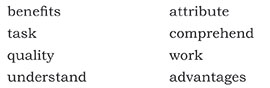
2. Match the synonyms correctly.
3. How does reading make our life better? Suggest three ways.
4. How does reading exercise your mind?
5. Fill in the blanks with appropriate words.
(a) When we develop the habit of reading, we become more _______________ and _______________ in abilities to understand all types of information.
(b) Just like _______________ _______________ there has to be a determination to make reading a _______________ of your _______________.
2 2: Read the given passage carefully and answer the questions that follow.
Trees are like nature's superheroes. They give us fresh air to breathe, cool shade on hot days, and homes for animals. But these amazing trees are in trouble. People are cutting them down for things like buildings and paper, and the climate is changing, making it harder for trees to survive. We can be tree heroes too! Planting new trees, using less paper, and being careful about where we get our wood from are ways we can help. Trees also help fight climate change by taking in the bad stuff from the air. When we save trees, we help the environment, keep our planet healthy, and make sure we have a good future. So, let's be tree heroes and protect these amazing natural wonders!
1. From the passage find antonyms for the following words.
(a) villains - _______________
(b) easier - _______________
2. From the passage find synonyms for the following words.
(a) difficulty - _______________
(b) fit - _______________
3. What are some of the things that trees provide us with?
4. Why are trees in trouble, according to the passage?
5. How can we become tree heroes?
6. How do trees help fight climate change?
7. What is the main message of the passage about saving trees?
3 3: Read the given passage carefully and answer the questions that follow.
Yoga is like a secret recipe for a happy and healthy life. It's not just about stretching and bending; it's about feeling good inside and out. When we do yoga, we gently move our bodies in different ways, like reaching for the stars or touching our toes. It makes our muscles strong and helps us stand tall and straight. Yoga also helps our minds stay calm and focused. It's like a magic spell that makes stress disappear. We can breathe deeply, like blowing up a big balloon, and it makes us feel relaxed and peaceful. So, yoga is like a special tool that keeps our bodies and minds in great shape, helping us feel happy and peaceful every day. It's like a little secret for a big, beautiful life.
1. What does yoga help our minds do, according to the passage?
2. How does yoga make our muscles strong and help our posture?
3. What is a key benefit of yoga for our bodies?
(a) Learning to sing
(b) Moving in different ways
(c) Eating more
(d) Watching TV
4. How does yoga affect our minds?
(a) Makes stress disappear
(b) Makes us want to dance
(c) Makes us sleepy
(d) Makes us talk a lot
5. How is deep breathing in yoga compared in the passage?
(a) Like deflating a balloon
(b) Like flying in the sky
(c) Like holding your breath
(d) Like running a race
6. Find a synonym for “unwound” as used in the passage.
7. What is the opposite of “distracted” in the context of yoga?
4 4: Read the given passage carefully and answer the questions that follow.
Traffic rules are like the superheroes of the road. They keep us safe and make sure everything runs smoothly. These rules tell us important things like how fast we can drive, when to stop at a red light, and why we should let people walk safely. They're not there to make us feel bad but to keep everyone out of harm's way. Putting on seatbelts, helmets, and staying in the right lane is like wearing our own armour. It protects us from accidents. These rules also say no to dangerous things like drinking and driving. By following these rules, we're like traffic heroes, making the roads safer for all of us. It's like a team effort to prevent accidents, save lives, and keep traffic moving nicely. So, remember, traffic rules are there to help and protect us all.
1. From the passage find antonyms for the following words.
(a) safe- _______________
(b) harm- _______________
2. From the passage find synonyms for the following words.
(a) attempt - _______________
(b) obeying - _______________
3. What is the role of traffic rules on the road, according to the passage?
4. Why do traffic rules exist, and what is their purpose?
5. How do seatbelts and helmets act as protection while on the road?
6. What are some dangerous behaviours that traffic rules discourage?
7. What does following traffic rules make us on the road, as described in the passage?